Welcome to Micron.com, please Log in or Register an account to continue.





- US - English
- China - 简体中文
- India - English
- Japan - 日本語
- Malaysia - English
- Singapore - English
- Taiwan – 繁體中文
Flexible memory expansion for data-intensive workloads
Memory expansion that increases capacity, optimizes cost, and intelligently balances performance between compute and memory resources.
Speak with Micron today and secure up to 24%1 greater memory bandwidth per core.
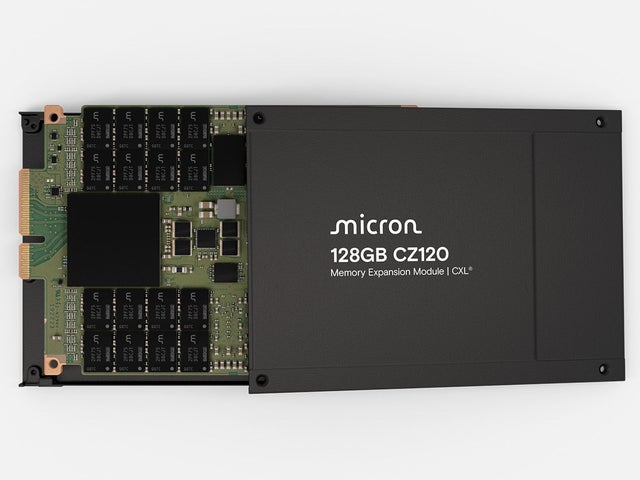

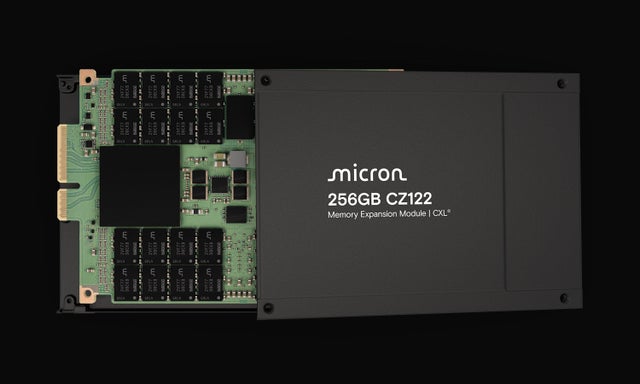
Featured CXL technology resources




Additional CXL memory resources


Frequently asked questions about CXL memory
CXL 1 device (CXL.io)
The first type of CXL protocol is used for device initialization, link-up, enumeration and device discovery. It is used for devices like FPGAs and IPUs that support CXL.io. CXL 1 devices implement a fully coherent cache but no host-managed device memory.
CXL 2 device (CXL.cache)
This second type of CXL protocol implements an optional coherent cache and host-managed device memory. Typical CXL 2 devices and applications have high-bandwidth memory attached.
CXL 3 device (CXL.mem)
The third type of CXL protocol is used only for host-managed device memory. Typical CXL 3 applications are as memory expanders for the host.
The key advantage of CXL technology is the expansion of the memory for compute nodes, filling the gap for data-intensive applications that require high bandwidth, capacity, and low latency.
Modern compute architectures are prone to the “memory wall” problem. CXL memory expansion provide the necessary architecture to bring balance to the compute and memory scaling gap.
It creates a new vector to achieve economically viable memory solutions through memory expansion, impacting DRAM bit growth rate.
Additionally, CXL’s flexible and scalable architecture provides higher utilization and operational efficiency of compute and memory resources to scale-up or scale-out resources based on workload demands.
Modern parallel computer architectures are prone to system bottlenecks that limit performance for application processing.
Historically, this has been known as the “memory wall”, where the rate of improvement in microprocessor performance far exceeds the rate of improvement in DRAM memory speed.
CXL protocol properties for memory-device cohesion and coherency address the memory wall by enabling memory expansion beyond server DIMM slots.
CXL memory expansion serves as a two-prong approach by adding bandwidth to overcome the memory wall as well as adding capacity for data-intensive workloads for CXL-enabled servers.
CXL memory expansion provides tremendous opportunity for growth in new areas for tiered memory storage and enabling memory scaling independent of CPU cores.
CXL will help sustain a higher rate of DRAM bit growth, but while it's a net positive for DRAM growth, don’t expect CXL to cause an acceleration in DRAM bit growth
Micron’s commitment to CXL technology enables customers and suppliers to drive the ecosystem for memory innovation solutions.
To learn more on how Micron is enabling next-generation data center innovation on our data center solution page.
CXL memory expansion are a cost-effective, flexible, and scalable architectural solution that will shape the data center of the future. It will change how traditional rack and stack architecture of servers and fabric switches are deployed in the data center.
Purpose-built servers that have dedicated fixed resources comprising CPU, memory, network and storage components will give way to these more flexible and scalable architectures.
Servers in the rack – once interconnected to fixed resources for network, storage and compute – will be dynamically composed to meet the demands of modern and emerging workloads such as AI and deep learning.
Eventually, the data center will migrate towards complete disaggregation of all server elements, including compute, memory, network, and storage.

1. MLC bandwidth using 12-channel 4800 MT/s RDIMM + 4 x 256GB CZ120 vs. RDIMM only.